Setting up targeting (geography, time, devices, audiences, etc.)

Imagine that you've already launched an ad campaign.
- The target audience is 10/10 and is located all over the world, but the company does not offer shipping, and its initial target is a specific country and city;
- The text and visuals are 10/10, but the ads are shown outside of business hours;
- Goal setup is a 10/10, but the company's website isn't optimized for mobile.
To ensure your campaign is 100% effective and performs as intended, there’s a mechanism called targeting (from the English word “target”)—a mechanism that determines who sees your ads, where, when, and on which devices. The main goal of targeting is to narrow down the user audience so that the people clicking on your ads aren’t just visitors, but future customers interested in making a purchase “right here, right now.”
In addition, he:
- Reduces the proportion of irrelevant impressions by attracting the audience most interested in making a purchase;
- It helps segment the audience based on their needs;
- It allows you to test various offers across different target audience segments;
- It helps bring back customers who have already interacted with the brand to make new purchases.
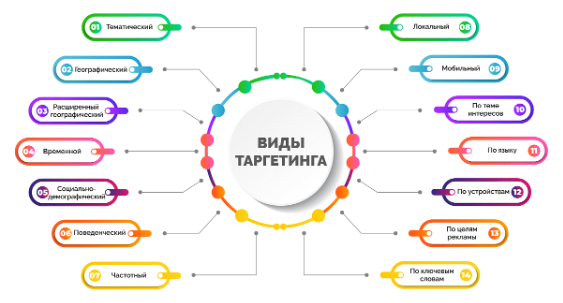
There are several types of targeting that use different characteristics as their “target” (the target audience is subsequently segmented based on these characteristics). In this article, we will focus in more detail on just a few of them.
Social and Demographic
Age, gender, marital status, language, income level, or occupation—all of these are criteria for this type of targeting. It’s a convenient filter that helps weed out segments that are obviously unsuitable. However, relying solely on it is risky and insufficient. For example, “men aged 30–45” is too broad and diverse a group for the same message to work for all of them.
Geotargeting
This type of targeting limits ad impressions based on geographic criteria: country, region, city, district, or a specific radius around your address. For businesses with an offline presence (salons, repair shops, delivery services), geotargeting is one of the most important settings.
A common mistake is targeting an entire region, even though in reality the manager only makes house calls or deliveries are limited to the city or a few nearby neighborhoods.
Behavioral
It analyzes a user’s “digital footprint”: what they searched for, which websites they visited, what they added to their cart, and which product categories they’ve responded to in the past. This approach provides a much more accurate picture of your target audience’s actual interests than simple demographics.
This is a good option for broad-reach campaigns where the goal is to introduce the audience to the brand. However, this type of targeting has its own nuances that must be taken into account when setting it up:
- This type of targeting generates mixed traffic, since the ads are based on users' presumed interests and hobbies;
- It requires properly configured analytics and a large dataset for behavioral patterns to become statistically significant.
Retargeting
Retargeting — this is a form of engagement with those who have already interacted with the company: visited the website, explored services, abandoned a shopping cart, or read a specific article. In Russian-speaking contexts, the terms “retargeting” and “remarketing” are often used interchangeably to refer to the same mechanism—re-engaging an audience that is already familiar with the company.
To make sure everything runs like clockwork, we set up our ads in stages. Let's take a look at how this works.
The essence of targeting is to display ads on social media to users who haven’t directly expressed an interest in purchasing something, but who might potentially be interested in that product or service. So, at the start of the project, our specialists analyze information about your users and target audience, and then segment it based on various criteria. For example, if the majority of your company’s customers are young people aged 18 to 25 from Chelyabinsk who are interested in rock culture, a marketer can run ads targeting that specific segment of the audience.
Why does your business need this?
It's simple—precise targeting ensures that ads are shown only to users who are actually likely to become customers, which means resources are used efficiently. At the same time, this eliminates irrelevant ad impressions—for example, in regions where delivery isn't available, or late at night when managers aren't available to respond.
Without careful targeting, however, ads will be shown to a random audience at the wrong times and in the wrong places. As a result, your budget will be wasted on impressions and clicks that are obviously useless and won’t lead to actual sales.
Total
Setting up targeting by geography, time, devices, and audiences isn’t just an optional feature—it’s an essential step in any effective contextual advertising campaign. It’s what transforms a broad-reach channel into a personalized tool that speaks to the right people in the right place at the right time.
Other blog posts